Jordan Bennett · 15 September 2026
The Evolution of Silence as a Motif Across Musical Scores and Poetic Texts in 20th Century Arts
Early Experiments in Musical Notation
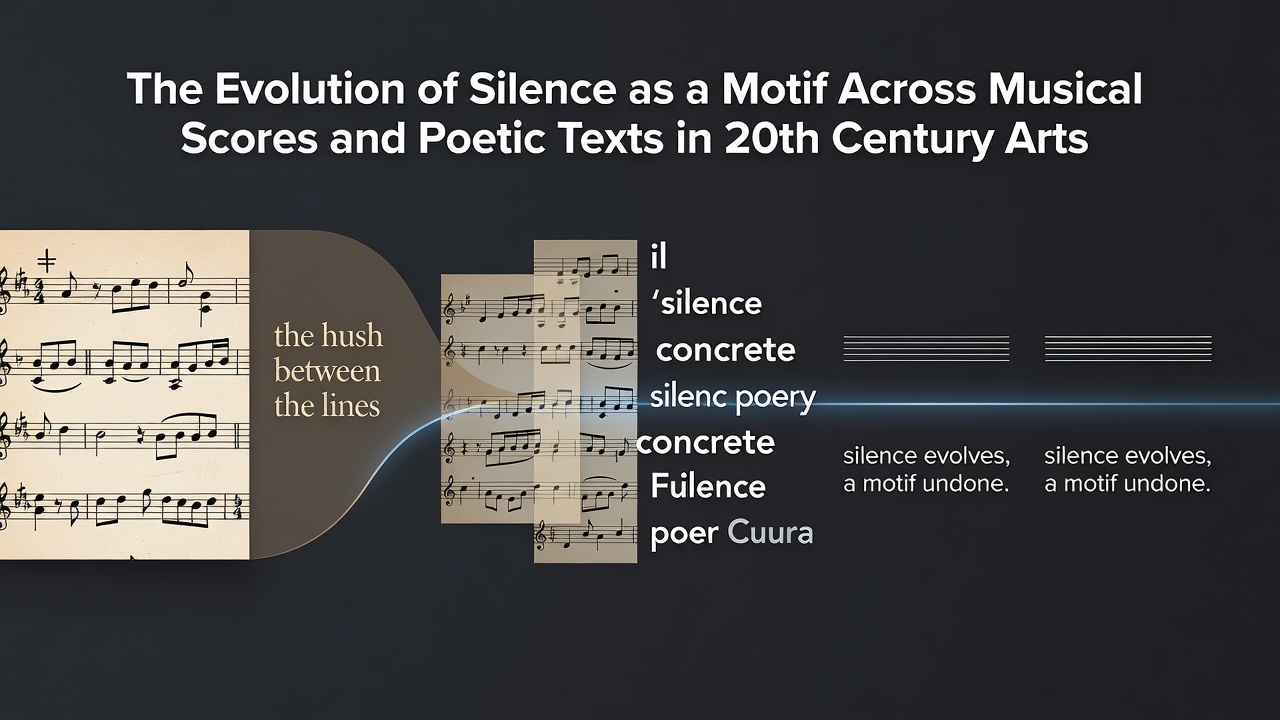
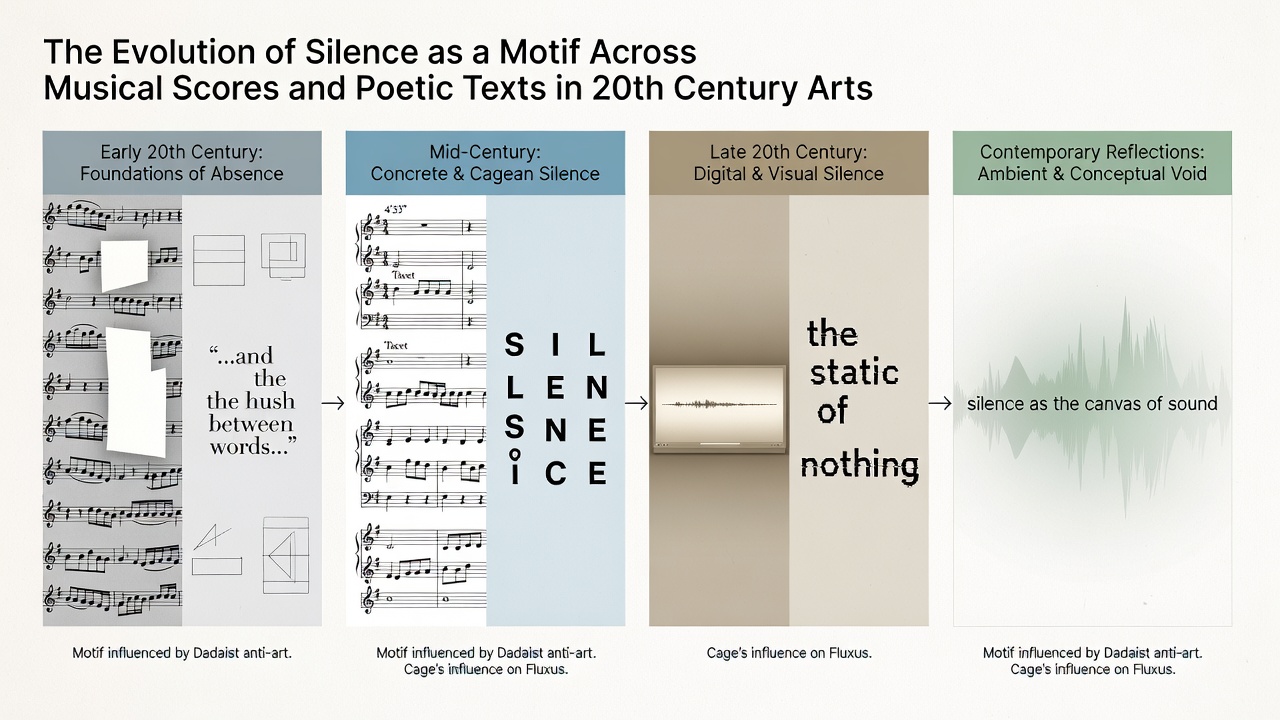
Composers in the opening decades of the 20th century began treating silence not as absence but as an active structural component, and this shift appears clearly in works where rests and fermatas extend beyond conventional phrasing. Scores from that period show deliberate gaps that interrupt melodic lines, while performers received instructions to hold notes or pauses for measured durations rather than interpretive freedom. Researchers examining manuscripts from the 1910s and 1920s have documented how these choices altered audience expectations during live performances, since listeners encountered stretches of soundlessness framed as intentional rather than accidental.
Poetic Texts and the Use of White Space
Poets working in the same era adopted parallel techniques through typographic layout, leaving large areas of the page blank to create visual pauses that correspond to moments of unspoken thought. Texts published between 1920 and 1940 frequently arrange words in irregular clusters separated by wide margins, and these arrangements force readers to navigate the absence of language as part of the meaning-making process. Scholars at institutions across North America and Europe have catalogued examples where line breaks and stanza gaps function as rhythmic devices equivalent to rests in music, and archival comparisons reveal consistent patterns across multiple languages and national traditions.
Mid-Century Developments and Expanded Techniques
By the 1950s and 1960s the motif gained further complexity when composers integrated electronic means to control the precise length of silent intervals, and poets simultaneously explored concrete forms that turned the page itself into a temporal field. Data from performance records indicate that audiences at premieres in major concert halls encountered pieces in which silence occupied equal or greater duration than sounded material, while printed collections of poetry from the same years display grids of empty space calibrated to reading speed. Observers note that these approaches coincided with broader cultural interest in perception and attention, although the artistic decisions remained grounded in specific notational and typographic choices rather than abstract theory.
Cross-Disciplinary Influences and Documentation
Archives maintained by research libraries in the United States and Australia preserve correspondence between musicians and writers who exchanged ideas about duration and emptiness during the postwar decades, and these documents show repeated references to shared concerns over how audiences register time when sound or language ceases. Studies published by academic presses detail how silence motifs migrated between media through collaborations, festival programs, and printed anthologies that paired scores with poems. Figures from European institutions have compiled chronologies that track the increasing frequency of such works in both concert programs and literary journals throughout the 1970s and 1980s.
Late-Century Refinements
Toward the end of the century composers refined earlier experiments by specifying exact decibel thresholds for ambient noise during silent passages, while poets incorporated digital typesetting to control spacing at the pixel level. Performance data collected by orchestras and reading series reveal that these later works often required audiences to remain in controlled acoustic environments for extended intervals, and printed editions included precise measurements for margins and leading. According to records from international arts organizations, the cumulative effect appears in festival schedules that programmed paired music and poetry events built around the motif.
Conclusion
Across the 20th century the motif of silence evolved from isolated notational or typographic device into a recognized structural element documented in scores, manuscripts, and performance histories. Institutions continue to digitize primary sources, and researchers maintain ongoing catalogues that connect early experiments with later refinements. A retrospective exhibition and performance series scheduled for September 2026 at a major European archive will present original scores alongside annotated poetic texts, allowing direct comparison of the techniques developed over the preceding decades.